Designing internal tools within complex operational systems

Operational UX for Logistics & Fulfillment

Role
UX Researcher
Date
2021–2022
User
WireXpress customers seeking easy access to products and account information without needing constant rep interaction
Tools
Interviews, Surveys, Market Scan, Journey Mapping, Analytics Review
WireXpress, a specialty distributor within Wesco/Anixter, relied heavily on relationship-driven, white-glove service to manage customer orders—making even small, routine requests dependent on sales representatives. Leadership wanted sales teams to focus on high-value accounts while enabling smaller customers to independently find products, place orders, and manage quotes. I led foundational research to understand customer and employee expectations, uncover operational friction, and define a research-backed path for how the website could better support the business without disrupting existing relationships.
Challenges
The project faced several intertwined challenges. Culturally, many sales representatives were skeptical of a more capable digital platform, viewing it as unnecessary or as a threat to relationship-driven service. The existing website reinforced this belief—it functioned primarily as a contact point for sales reps and a passive reference for quotes and orders, with most work still handled through email and manual processes.

Technically and operationally, the underlying systems were not designed to support self-service or continuity. Orders, quotes, and product information lived across disconnected tools and inboxes, making it difficult for customers to complete tasks independently or transition between sales reps without friction.

At the same time, while leadership acknowledged persistent customer and internal pain points, there was limited data to quantify them. Pressure to move quickly toward redesign made it necessary to establish the value of foundational research and benchmarking—using evidence to validate assumptions, prioritize problems, and create a shared understanding of what the digital experience needed to support before design work could responsibly move forward.

Approach

I led a discovery research phase
that combined customer and market insights to guide the redesign
Stakeholder Interviews
Surface organizational assumptions, resistance, and operational constraints
Customer Research
Understand real customer behaviors, expectations, and unmet needs
Market Scan
Benchmark digital experiences and expectations within the distribution industry
Journey Mapping
Identify breakdowns in current workflows where digital tools could reduce friction
Insight Synthesis
Translate research into clear priorities for what the website should, and should not, support

Design Thinking Process

Discover & Define
  • Stakeholder interviews
  • Customer surveys + interviews
  • Market scan of competitor digital tools
  • Journey mapping for current workflows
Explore & Organize
  • Affinity mapping of user needs vs. business goals
  • Framing digital opportunities as “complements” not “replacements” for sales reps
  • Prioritization of features with clear ROI (e.g., product search, account info, order status)
Test & Communicate
  • Research readouts with cross-functional teams
  • Storytelling with personas and journeys to build empathy
  • Recommendations presented as phased roadmap for future redesign

Impact

This research reframed leadership’s assumptions about customer behavior,
directly shaping WireXpress’s digital strategy and laying the foundation for its first major website redesign.
Validated customer priorities
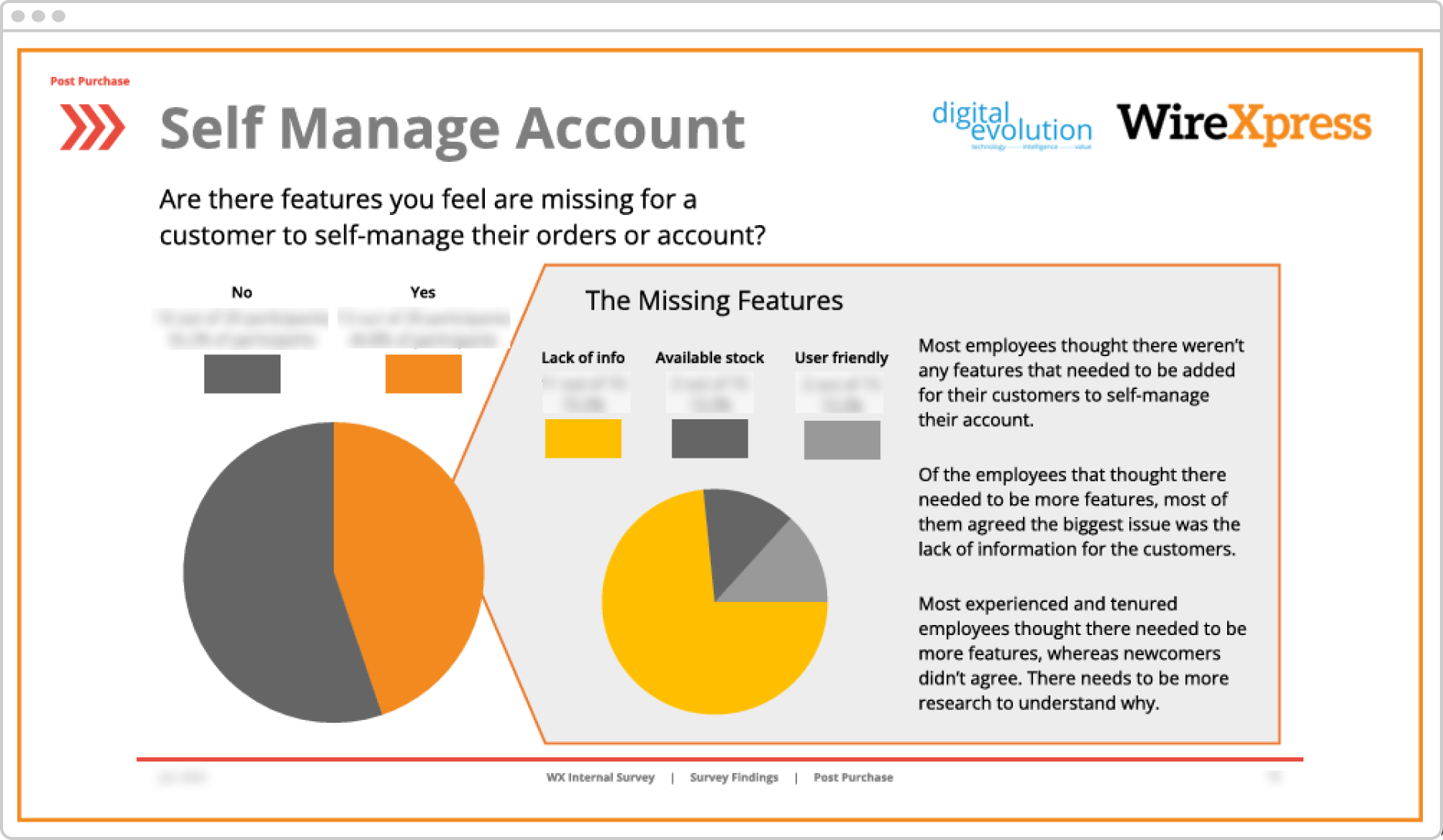
Customers weren’t interested in buying online, but strongly valued being able to search products, check pricing, and manage accounts independently
Shaped digital strategy
Reframed the website not as a sales replacement, but as a complementary self-service channel that freed reps to focus on larger accounts
Built organizational alignment
Research findings helped overcome internal resistance by grounding the redesign in data, not assumptions
Laid groundwork for redesign
Delivered a roadmap of features and content priorities that guided WireXpress’s first serious digital overhaul
By grounding the project in customer research, I helped WireXpress reimagine its digital role—shifting from a static catalog to a strategic self-service tool that supports customers and empowers sales teams.

More Case Studies